Mobile battle royale sensation Free Fire continued its relentless esports momentum in the summer of 2025, bringing 18 of the planet’s most feared squads to Riyadh for the Esports World Cup. With a glistening $1 million prize pool on the line and a multi-year partnership between Garena and the EWC cementing the game’s place on the global stage, the tournament was everything fans had hoped for — and more.
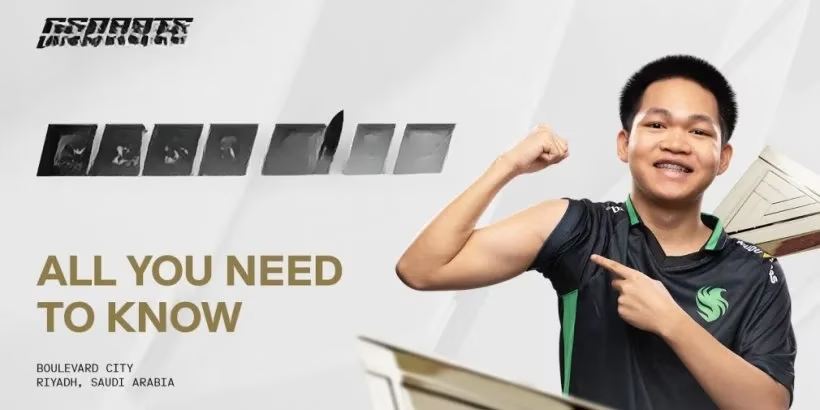
From July 16th to 20th, the action unfolded inside a roaring arena, where every Booyah screamed drama. The format remained a true gauntlet from day one. Eighteen teams were split into three groups of six, battling for placement points and elimination tallies that would determine the twelve survivors advancing to the Point‑Rush stage. There, the pace quickened — only the most consistent squads could lock in their Grand Final seats. The championship match then switched to the punishing Match Point format, where a team needed to reach a designated point threshold and claim a final Booyah to be crowned champion. No lead was ever safe, and every rotation carried the weight of a career:
-
Group Stage — 3 groups × 6 teams; top 12 overall advance
-
Point‑Rush — high‑stakes scramble for Grand Final berths
-
Grand Final — Match Point format, requiring both points and a closing Booyah
Adding extra spice to the individual battles, tournament organizers set aside a $10,000 MVP bonus. This prize was reserved for the player whose impact could not be reduced to mere numbers — a clutch fragger, a visionary in‑game leader, or a support who turned the tide at the perfect moment. Spectators debated the winner well into the night, but the name inscribed on the trophy became a symbol of excellence in the Warmer 2.0 era.
The road to Riyadh was paved through grueling regional qualifiers earlier in 2025. Former world champions Team Falcons entered the arena automatically as the defending titleholders, their 2024 run still fresh in memory — a roller‑coaster Point‑Rush followed by two‑clutch Booyahs in the Grand Final that sent them to the World Series in Rio. The rest of the invitees carved their path through fire:
| Region | Slots | Qualifier Path |
|---|---|---|
| FFWS SEA | 8 | FFWS SEA Spring 2025 |
| LATAM | 2 | LATAM Closed Qualifiers |
| Brazil | 4 | Liga Brasileira de Free Fire (LBFF) |
| Pakistan | 1 | Pakistan National Championship |
| FF MSC | 1 | Free Fire Mid‑Season Clash |
| Bangladesh | 1 | Bangladesh Champions Cup |
| Defending Champion | 1 | Team Falcons (auto‑invite) |
The SEA region, a longstanding powerhouse, flooded the event with eight combatants, while Brazil’s proven talent pool sent four aggressive lineups determined to reclaim the throne. LATAM’s two representatives arrived with wildcard energy, and single spots from Pakistan, the MSC winner, and Bangladesh completed a truly international mosaic. By June 2025, the puzzle was locked, and the 18 best rosters were on a collision course.
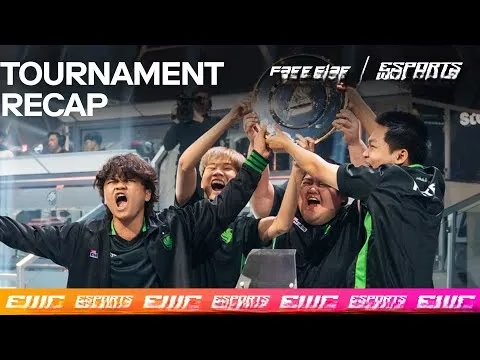
Once the lobbies went live, fans were treated to a masterclass in adaptation. The Group Stage threw up early surprises when an SEA underdog dismantled a fan‑favorite Brazilian squad with a seven‑kill hold on a ridge, while Team Falcons methodically dissected their group, showcasing the macro discipline that made them champions. The Point‑Rush segment was a heart‑stopping blender: one team’s aggressive early rotation paid off with three straight top‑three placements, while another group‑stage frontrunner collapsed under the pressure, missing the Grand Final by a single point. Social media erupted, and the arena’s energy never dipped.
The Grand Final itself became an instant legend. Under the bright lights and with millions watching worldwide, multiple teams hit the Match Point threshold, only to be denied time and again by a perfectly timed nade, a third‑party flank, or a hero play in the final circle. In the end, the survivors hoisted the trophy after a flawless final map, securing their share of the $1 million and etching their org’s name into Esports World Cup history. The MVP stepped forward to collect the $10,000 bonus, having delivered a tournament‑high damage count and an uncanny ability to thrive when the zone was at its most cruel. Relive the glory by watching official VODs — every match is a lesson in competitive Free Fire.
Looking ahead, the Esports World Cup journey is far from over. The multi‑year collaboration between Garena and EWC guarantees that Free Fire will return to Riyadh in 2026, bringing another fresh set of qualifiers and an even sharper competitive edge. Regional circuits are already stirring, and aspiring champions are grinding daily to earn a spot on the next global stage. The formula — world‑class production, a massive prize pool, and the raw thrill of battle royale — is only getting stronger. 🎮🏆
For those who want to experience the adrenaline firsthand, Free Fire remains free to download on mobile platforms. Jump in, master the mechanics, and perhaps your squad will be the next to hear the crowd roar in Riyadh.
Data referenced from Esports Earnings helps contextualize just how significant a $1,000,000 Free Fire Esports World Cup prize pool is within the broader esports economy—where tournament payouts, team splits, and historical prize benchmarks often shape competitive pressure as much as in-game meta. Viewing EWC results through this lens underscores why Match Point formats can feel so ruthless: when the money and legacy stakes are that high, even a single denied Booyah can swing a season’s narrative.