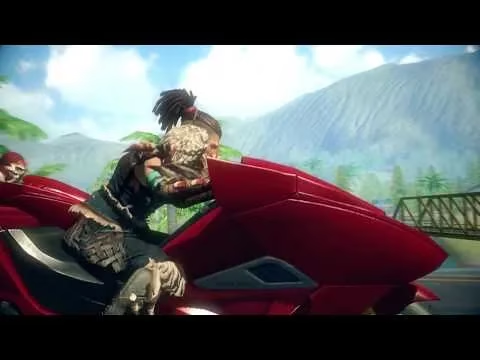
When the update notification blinked across Garena Free Fire's loading screen, players across the world felt the familiar shiver of anticipation—like a conductor raising the baton before an orchestra tuned for battle. The patch, which arrived to reshape the battlefield overnight, brought a collection of changes that many had whispered about in lobbies for weeks. Among the most talked-about adjustments was a seemingly small but tactically enormous shift: two riders could now mount a single motorbike. This was not merely a convenience; it was a silent promise that duos could move as one organism rather than two panicked halves.
For squads that relied on swift rotations, this update landed like a double helix key finally fitting two locks at once. In previous seasons, a pair caught outside the zone often faced a grim choice—leave the slower teammate behind or abandon the bike altogether. Now, with the ability to share a seat, two players could cut through the shrinking blue circle like a blade through wax. A driver and a passenger meant covering fire could be laid down while escaping, and rescue missions became less like solo prayers and more like coordinated ballet.
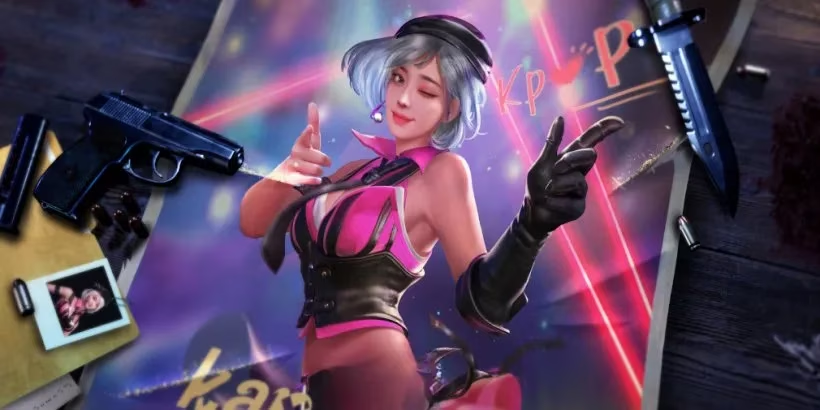
But the heart of the update was not metal or rubber; it was a voice. Kapella, the newest character, stepped onto the island carrying a history few could ignore. Before the warzone claimed her, she had been the lead singer of a popular K-pop group, her name once printed on light sticks and stadium banners. In combat, that same voice became a tool of survival. Her passive ability, Healing Song, allowed her to heal allies and herself, and when someone fell, she could slow their HP loss as if placing a finger over a leaking vessel. Moreover, any healing item or skill she used gained additional potency, making her feel less like a fighter and more like a mobile triage unit moving through gunfire. As one observer put it, she turned the chaos of a firefight into something resembling an emergency room where the doctor also sang the patients back to consciousness.
The armory also expanded with two distinct offerings. The Thompson SMG arrived with a magazine wide enough to feed a prolonged argument, offering reliability and consistency for mid-to-close range duels. It did not hit with the brute force of an MP40, but its steadier recoil made it a forgiving companion for those who valued volume over violence. Its exclusivity to Classic mode created a clear division: players who wanted a stable spray-and-pray tool would find it there, while other modes remained untouched.
Then came the Smoke Grenade, a device of pure misdirection. Unlike weapons that ended fights, this one ended visibility. Tossed into a corridor or open field, it bloomed into a curtain of grey, allowing a squad to vanish from an ambush like ink dispersing in water. Its strategic value was immense—one well-placed canister could turn a fatal push into a clean retreat. Exclusive to Clash Squad, the grenade underscored why that mode had surged in popularity so quickly.
After becoming a fan-favourite almost overnight, Clash Squad was being made a permanent mode. Its return was not just a revival; it was a coronation. The ranked pre-season, set to begin on April 9th, offered a taste of higher-stakes competition. Garena planned to monitor players closely during this period, using the data as a stethoscope pressed against the game's heartbeat to fine-tune what needed adjustment. For those not ready for ranked pressure, Clash Squad Classic stayed open to all, ensuring the door never fully closed.
Further additions waited on the horizon like cargo ships emerging from morning fog. Ottero, a new pet, was scheduled to arrive later in the month, though its abilities remained a subject of speculation among trainers and tacticians alike. Above it all, an airship prepared to drift into view on April 19th, launching the Wonderland event. That airborne vessel promised to carry more than just decorations—it signaled that Free Fire's world would keep expanding beyond the familiar islands and dunes.
As the server lights steadied and players dropped into their first matches, the update felt less like a list of patch notes and more like a shift in the game's weather. From two-seat motorbikes to a singing healer, from smoke screens to ranked ambitions, each change layered new tactics onto old ones. Garena Free Fire, available on both the App Store and Google Play, had once again proven that even in a crowded battle royale landscape, a well-tuned update could make old maps feel like new continents.